Cooking guides · 7 min read
The real science of a soft, medium, and hard-boiled egg
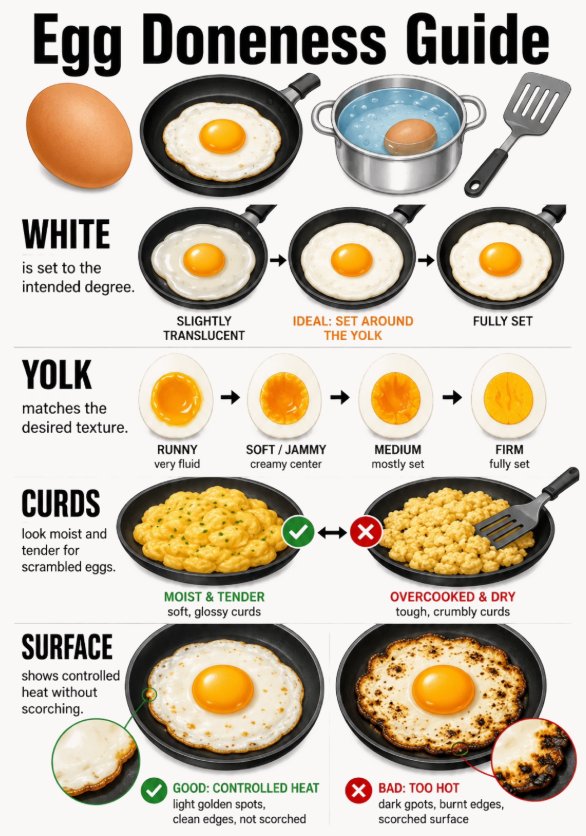
An egg cooks from the outside in. The white sets first, starting around 145°F (63°C), and firms up completely well before the yolk does. The yolk doesn't begin to set until closer to 150°F (65°C), and it doesn't fully firm up until around 158°F (70°C) or higher. That gap between white-set and yolk-set is the entire reason soft, medium, and hard-boiled eggs are even possible from the same starting point.
Time is really just a proxy for how far that heat has traveled into the yolk. At roughly six minutes in simmering water, the white is fully set and the yolk's edge has just started to firm while the center stays runny. By nine minutes, that firming has moved further in, leaving a jammy, half-set center. By twelve minutes, the heat has fully penetrated the yolk, producing the classic fully-set hard-boil.
Two things throw this timing off in a home kitchen: egg size and starting temperature. A jumbo egg needs roughly 30–60 extra seconds compared to a large egg at the same doneness, and an egg starting cold from the fridge cooks slightly slower than one closer to room temperature. Altitude also matters, since water boils at a lower temperature the higher up you are, which effectively slows the whole process down.
Cooking guides · 5 min read
Why do hard-boiled eggs get that greenish ring around the yolk?
That grey-green ring is a real chemical reaction, not spoilage. When an egg is boiled too long or at too high a heat, sulfur compounds in the white react with iron in the yolk, forming iron sulfide right at the boundary between the two. It's harmless to eat — it just means the egg was cooked a bit longer or hotter than it needed to be.
The fix is mostly about stopping the cooking at the right moment. Boiling gently rather than at a rolling boil, and moving the eggs into an ice bath the instant they're done, both reduce the ring significantly because they cut off the extra heat that keeps driving that reaction after the eggs are technically "done."
Cooking guides · 4 min read
Why do older eggs peel easier than fresh ones?
This trips a lot of people up, because it's the opposite of what you'd expect. A very fresh egg has a lower internal pH and a membrane that clings tightly to the shell, which makes peeling frustrating — you tend to tear off chunks of white along with the shell. As an egg ages over one to two weeks, its pH rises and that membrane loosens its grip.
If you're boiling eggs specifically to peel them, eggs that are roughly 7–10 days old tend to peel far more cleanly than eggs bought that same morning. This is also part of why some boiled-egg products (including subscription or made-to-order ones) intentionally use eggs that have had a few days to age rather than the absolute freshest stock.
Cooking guides · 3 min read
Quick reference: doneness by time
As a general baseline for large eggs at sea level, added to already-simmering water:
- 6 minutes — runny yolk, fully set white (soft)
- 9 minutes — jammy, half-set yolk (medium)
- 12 minutes — fully set yolk (hard)
Adjust up 30–60 seconds for jumbo eggs, or if you're above roughly 3,000 feet of elevation. Always shock in an ice bath immediately after boiling to stop the cooking and make peeling easier.