Nutrition · 5 min read
Is the yolk or the white better for you?
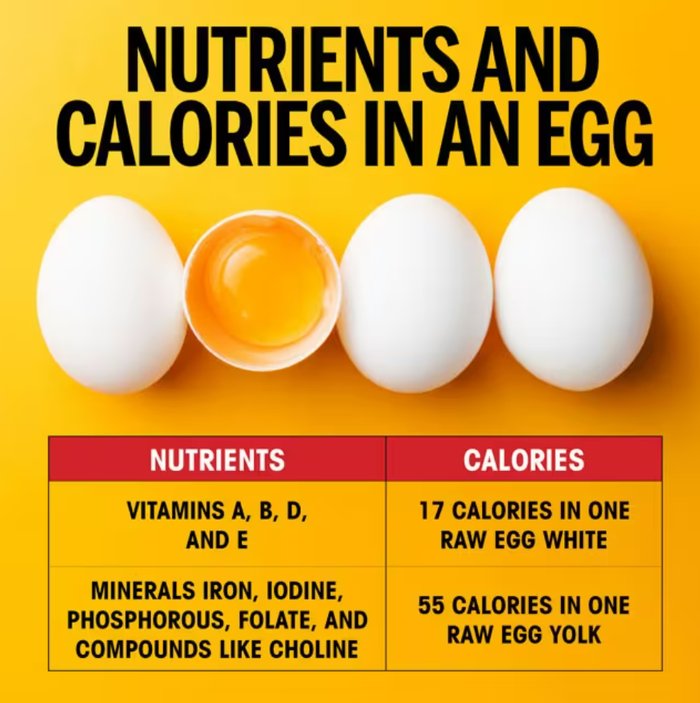
A whole egg splits its nutrition fairly unevenly between yolk and white, and each half is doing different work. The white is almost pure protein — about 4 grams of it — with very little else going on. It's low-calorie, fat-free, and easy to digest, which is why it shows up so often in high-protein, low-calorie meal plans on its own.
The yolk is where almost everything else lives. It carries the fat, the cholesterol, and the majority of an egg's vitamins and minerals — vitamin D, B12, choline, selenium, and the lutein and zeaxanthin that support eye health. It also carries about half the egg's total protein, so skipping it isn't actually a protein-maximizing move.
Neither half is "the healthy one." The white gives you lean protein with almost nothing else attached; the yolk gives you a dense package of micronutrients along with some fat and cholesterol. Most people are better served eating the whole egg unless a doctor has specifically advised otherwise.
Nutrition · 4 min read
How much protein is actually in an egg?
A large egg has about 6 grams of protein, split roughly 3.5 grams in the white and 2.5 grams in the yolk. That protein is also considered "complete" — it contains all nine essential amino acids in proportions the body uses efficiently, which is part of why eggs are used as a reference standard in some protein-quality scoring systems.
For context, two large eggs get you to about 12 grams of protein for roughly 140 calories, which is a fairly efficient ratio compared to many other protein sources. That's part of why eggs show up so often in meal-prep and fitness-focused diets — the protein-to-calorie ratio holds up well against alternatives.
Nutrition · 4 min read
Do eggs actually raise your cholesterol?
This is one of the more revised pieces of nutrition guidance in the last couple of decades. Eggs are high in dietary cholesterol — about 186mg per large egg, concentrated in the yolk — but for most people, dietary cholesterol has a much smaller effect on blood cholesterol than saturated fat does. Current U.S. dietary guidelines no longer set a strict daily cholesterol limit for the general population.
That said, "most people" isn't "everyone." Some individuals are genetically more sensitive to dietary cholesterol and see a bigger response in their blood levels. If you have a personal or family history of heart disease, high cholesterol, or you're simply unsure how your body responds, this is worth a real conversation with a doctor rather than a blanket rule from an article — including this one.
Nutrition · 3 min read
What vitamins and minerals do eggs provide?
Beyond protein, eggs are one of the few natural food sources of vitamin D, which many people fall short on, especially with limited sun exposure. They're also a strong source of choline, a nutrient involved in brain and liver function that a large share of adults don't get enough of from a typical diet.
Rounding that out, eggs provide vitamin B12, selenium, riboflavin, and the antioxidants lutein and zeaxanthin, which are specifically linked to eye health. Almost all of this micronutrient content sits in the yolk, which is the main reason nutrition-focused sources tend to recommend eating the whole egg rather than whites alone.
Nutrition · 6 min read
How many eggs should you actually eat — per day, per week, per month?
Daily. For most healthy adults without existing heart disease, current research supports up to two eggs a day as part of an otherwise balanced diet. The American Heart Association specifically recognizes up to two eggs a day as compatible with a heart-healthy eating pattern for healthy older adults, and newer trial work has found that two eggs a day — eaten alongside a diet that's already low in saturated fat — can go along with reductions in LDL ("bad") cholesterol rather than the increases people used to assume. A daily egg or two is also one of the more reliable ways to hit a meaningful choline intake, a nutrient tied to brain and liver function that most adults fall short on.
Weekly. Zoomed out to a week, the strongest and most consistent evidence sits around 3 to 7 eggs — roughly half an egg to one egg a day, on average. Large reviews looking at heart disease risk have found that eating about seven eggs a week is associated with lower cardiovascular risk compared with eating none at all. Cognitive research points to a similar range: studies following older adults have linked moderate egg intake, around half an egg to one egg daily, to a lower risk of cognitive decline and dementia, with the benefit driven largely by choline. Interestingly, a couple of these same studies found that pushing well past one egg a day didn't add further benefit and in some cases reversed it — which is the main argument for a weekly rhythm over just maxing out every single day.
Monthly, and the bigger picture. Over a month, what matters most isn't hitting an exact number — it's consistency in the moderate range and what the eggs are replacing or displacing in your diet. A pattern of roughly 12–20 eggs a month (call it 3–5 a week) captures most of the studied benefit — steady choline and protein intake, better satiety, support for eye and brain health — without venturing into the higher intakes where the evidence gets thinner and more mixed. Some official guidance is more conservative still (a few international guidelines suggest as few as 2–4 a week), which is a reminder that "how many eggs" is really a question about your overall diet and personal health history, not a single universal number.
None of this replaces individual medical advice. People with diabetes, existing heart disease, or a known sensitivity to dietary cholesterol respond differently to egg intake than the general population, and should treat these ranges as a starting point for a conversation with a doctor rather than a rule.