Storage & safety · 6 min read
Do eggs really need to be refrigerated?
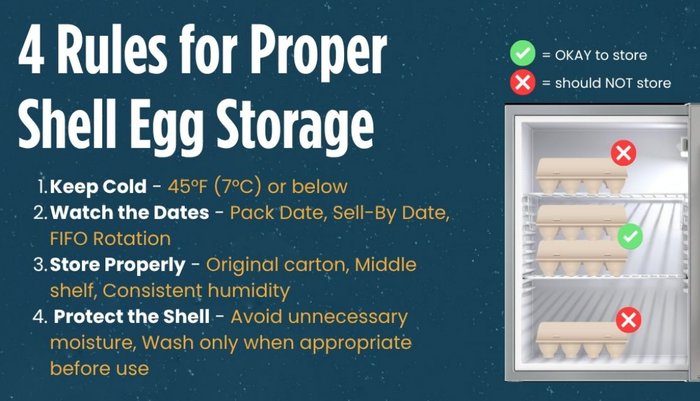
The honest answer is: it depends on the egg, specifically whether it's been washed. In the United States, commercial eggs are washed and sanitized before sale, which removes a natural protective coating called the "bloom" or "cuticle." Without that coating, bacteria can more easily pass through the shell's pores, so washed eggs need refrigeration to stay safe.
In much of Europe, eggs are typically not washed, and that natural coating stays intact. Unwashed eggs with an intact bloom can safely sit at room temperature for a couple of weeks, which is why egg aisles in European grocery stores are often unrefrigerated — it's not that European eggs are inherently different, it's that the washing standards differ.
The practical takeaway: if you bought your eggs from a standard US grocery store, keep them refrigerated, and don't let them sit out for more than about two hours. If you're getting eggs directly from a farm that doesn't wash them, room temperature storage is more reasonable for a shorter window, but refrigeration will still always extend their usable life.
Storage & safety · 4 min read
How long do eggs actually last in the fridge?
Refrigerated raw eggs in their shell generally stay good for 3 to 5 weeks past their pack date, which is considerably longer than most people assume. The "sell by" or "best by" date on a carton is a freshness guideline set by the retailer or producer, not a hard safety cutoff — eggs are very often still perfectly good to eat for some time after that date.
Once cooked, the timeline shortens considerably. Hard-boiled eggs, whether peeled or unpeeled, should be eaten within about a week when refrigerated. This is part of why boiled egg products meant for grab-and-go use are typically built around a short shelf window rather than a multi-week one.
Storage & safety · 5 min read
How can you tell if an egg has gone bad?
The float test is the simplest home check: place the egg in a bowl of water. A fresh egg sinks and lies flat on its side. As an egg ages, air gradually enters through the shell's pores, forming a small air pocket that grows over time — an older but still-fine egg will often stand upright on the bottom. An egg that actually floats to the surface has enough trapped air that it's likely gone bad and should be discarded.
Beyond the float test, trust your senses. A spoiled egg has an unmistakable sulfur smell the moment it's cracked open — there's rarely any ambiguity about it. Visually, discard any egg with a pink, iridescent, or noticeably discolored white, as that can indicate bacterial contamination.